
Decide
Decide builds a request for POST /v1/decide, the
same handler as ignis’s System One-compatible POST /v1/systemone, sends
it, and draws what comes back. A decision is one piece of evidence (text,
a JSON record or an image) and any number of questions over it. The server
prefills the evidence once and reads each answer straight off the model’s
distribution: a yes/no, a choice or a score generates no token at all, so
twenty questions cost about what one costs, and every answer comes with the
probability of each option instead of a sentence to parse.
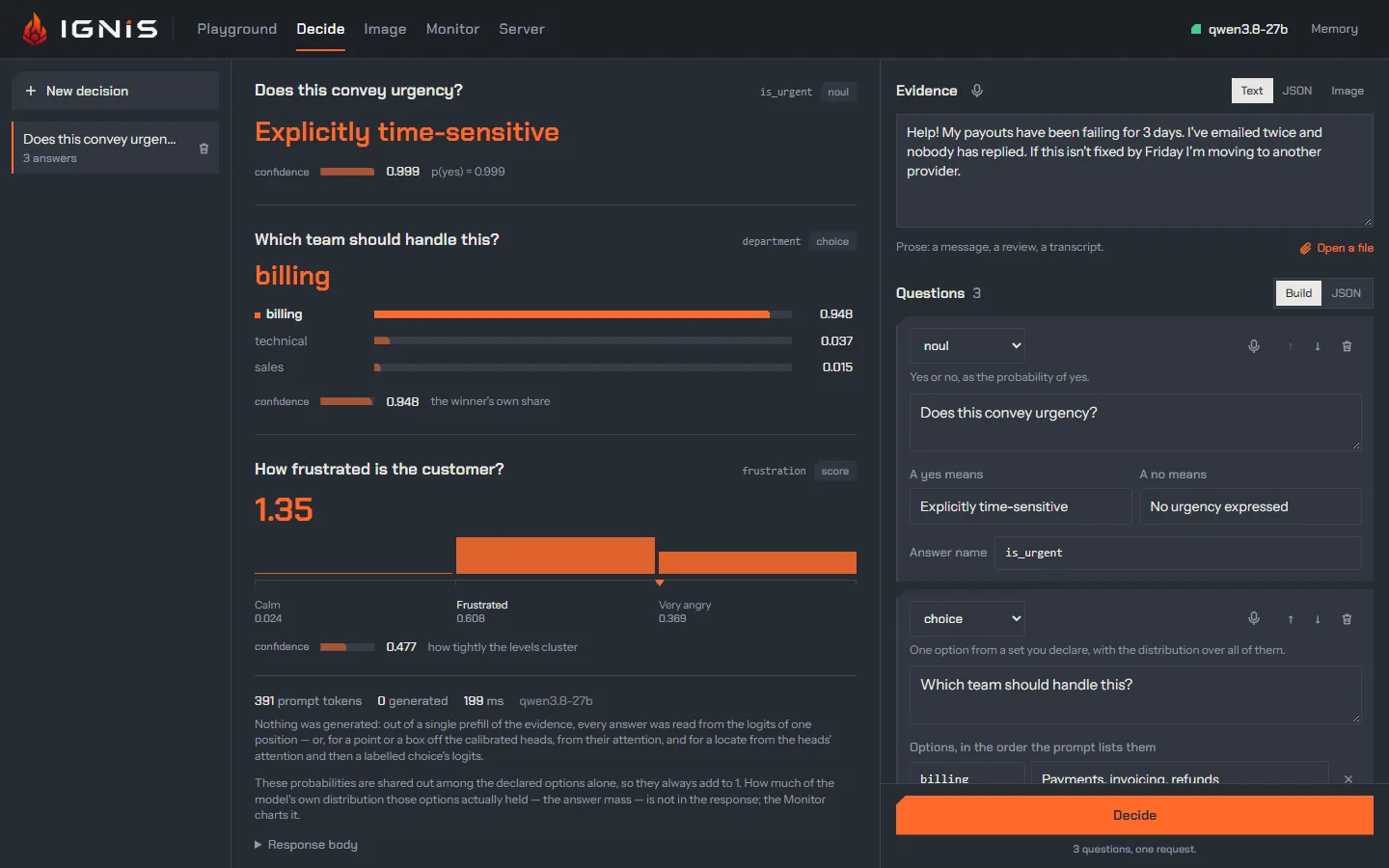
The view has three columns: Decisions on the left (kept in this browser, like the chat’s sessions), the answers in the middle, and the bench on the right, where the evidence and the questions are written.
Start from an example, or from your file
Section titled “Start from an example, or from your file”The opening screen offers your own file (a log, a document or a JSON file, chosen or dropped anywhere on the tab) and nine examples. An example fills the bench and sends nothing:
| Example | Shows |
|---|---|
| Triage one message | three questions over one message: a yes/no, a choice of department, a frustration score |
| Route to one of twelve | a wide choice whose distribution stays readable |
| Ask the Three Laws | eight dilemmas, each option an action and the law that would justify it |
| Read a structured record | evidence as JSON, not prose |
| Count something | a number, generated a digit at a time, each digit with its confidence |
| Ask without a width | a scalar that closes itself: 2.5, -0.75 |
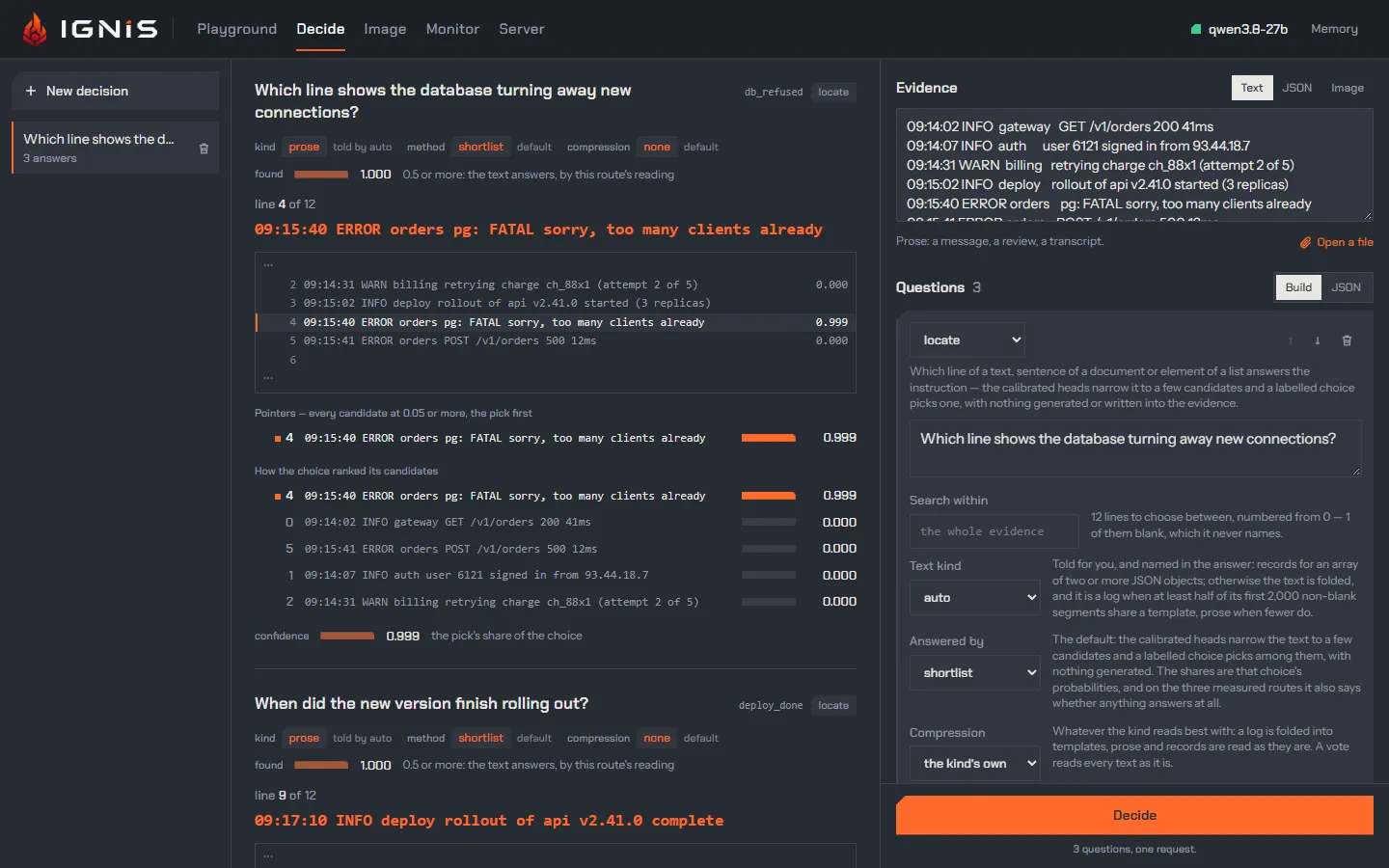
| Find the line in a log | locate: which line of a log answers a question, read off attention heads |
| Pick one from a list | locate within part of a JSON state |
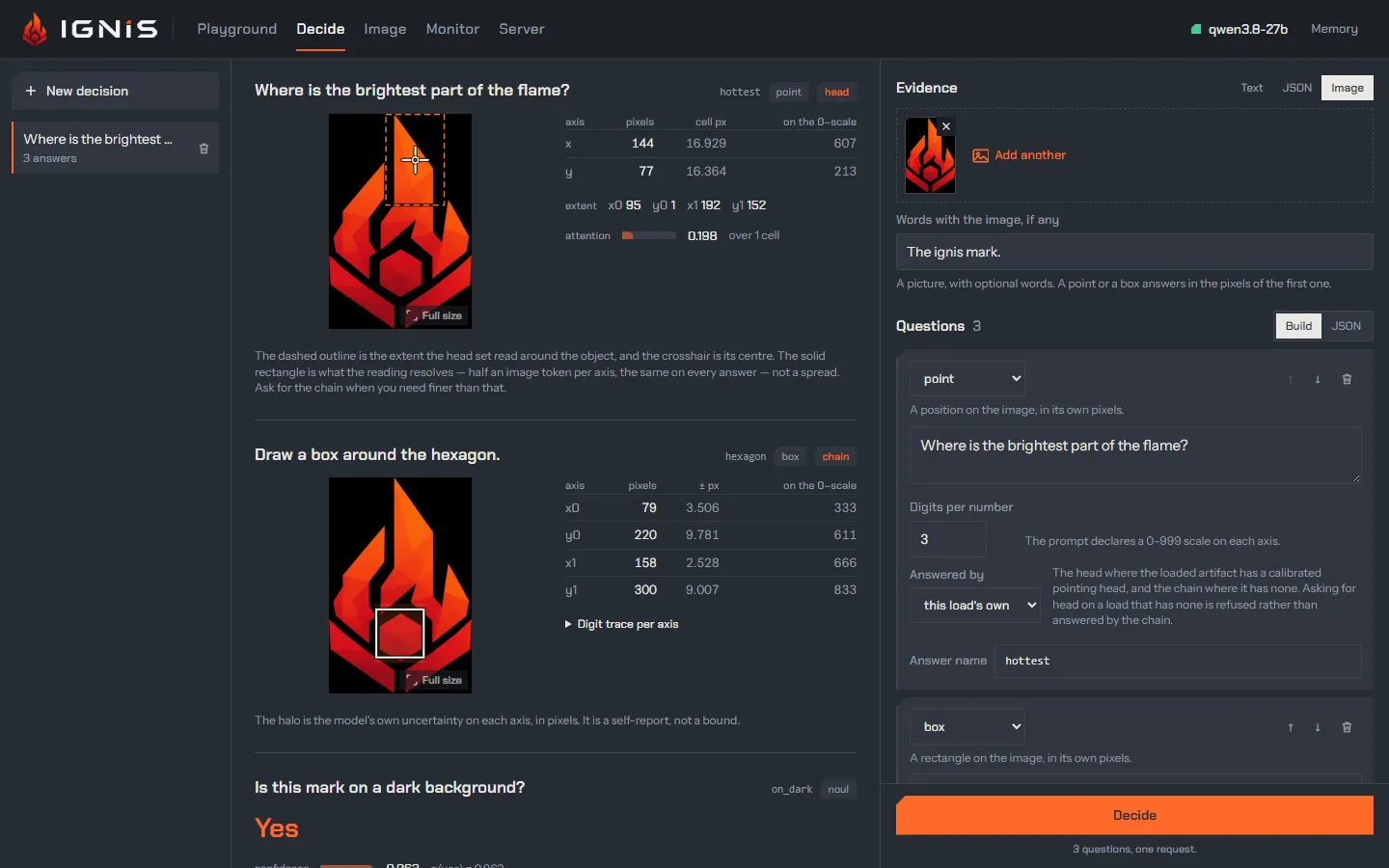
| Find it on an image | a point and a box in the pixels of the picture |
The evidence
Section titled “The evidence”Text, JSON or Image: switching keeps what each shape held. A file
loaded from disk shows as a card with its line count, a strip of the whole
file with errors and warnings tinted, and how it begins and ends; a JSON file
becomes a record, anything else text. Loading a file into an empty decision
adds a locate question for it. An image can carry words beside it; a point
or a box answers in the pixels of the first image.
The questions
Section titled “The questions”Each card is one question: its type, what the model should decide, the type’s own fields, and the answer name it comes back under.
| Type | Answers | Generated tokens |
|---|---|---|
noul |
yes or no, as the probability of yes | none |
choice |
one of the options you declare, with the distribution over all of them | none |
score |
a value across ordered levels: the weighted average, so it can land between two | none |
number |
a whole number, a digit at a time, each digit with its probability | one per digit |
scalar |
a number that ends when it is complete, fractional or negative | one per character |
point |
a position on the image, in its own pixels | one per digit, or none off the calibrated heads |
box |
a rectangle on the image | one per digit, or none off the calibrated heads |
locate |
which line, sentence or list element answers the instruction | none |
The order of a choice’s options is part of the prompt, and kept as written. JSON switches the bench to the request body itself, for anything the builder does not cover; it is exactly what Decide sends.
Dictating a question or the evidence
Section titled “Dictating a question or the evidence”Each prose field has a mic of its own: a question’s card on its top row (Dictate into Question), a Text evidence beside its heading (Dictate into Evidence). It works as the chat’s mic does, Ctrl+Shift+Space included, in the field it belongs to: the field keeps an ember border while you speak, the strip sits under it, the text lands at its cursor, and nothing is sent until you press Decide, which waits while any field is being dictated into. A JSON evidence, a file loaded as the evidence and the JSON request body have no mic: speech is for prose.
The context a dictation sends is the other prose on the bench first and the field’s own text last: the questions, then the evidence, for the evidence; the evidence, then the question, for a question. JSON never goes in, nor an evidence loaded from a file. Pressing another field’s mic ends the dictation under way: it is committed, and its text lands in its own field when it comes, while the new field listens.
The answers
Section titled “The answers”Decide sends one request; the footer says N questions, one request.
Answers come back in the request’s order:
- a yes/no shows the winning word, its confidence and
p(yes); - a choice shows the winner and a bar per option with its probability;
- a score shows the value on a bar chart over its levels;
- a number or scalar shows the value with its spread and a digit trace: the probability of each digit the model wrote;
- a point or box is drawn on the picture with its uncertainty, beside a table in pixels;
- a locate shows the line it picked, the lines around it, how the candidates ranked, and a strip of the whole text with the pick marked.
Under them: the prompt tokens, the tokens generated (zero when every answer
is a readout), the time the browser measured, and the model. Response body
opens the raw JSON. These probabilities are shared among the declared options
alone, so they always add to 1; how much of the model’s own distribution the
options held, the answer mass, is in the Monitor and the
metric ignis_decision_answer_mass.
Read more
Section titled “Read more”- System One decisions, without decoding: how it works and what was measured.
/v1/decide: the request and the response, field by field.