
Lanes that know who is asking
One card, eight lanes, and two kinds of request that look the same on the
wire: the conversation you are reading, and the subagents it sent off to search
the repository. When memory runs short, the server should not evict the
conversation to make room for a subagent’s tenth grep. In ignis a request
states which it is, with a lane tag of interactive or agent, and the
tag drives who is protected, who backfills first and who loses residency.
How it works
Section titled “How it works”The tag is an ignis extension: the class field, or an @<lane> suffix on
model. Absent or unrecognised is interactive. The exception is
/v1/decide, where absent means agent: a decision holds no residency and
never takes a decode lane, so interactive would only let twenty queued
questions cut ahead of conversations.
Admission is a state machine pinned by tests (ADR 0004). When a queued request is blocked, because no lane is free or its KV reservation does not fit, the active requests are frozen and the earliest-finishing set whose release makes the blocked one feasible is chosen as donors. A donor is not evicted while that protection is open. Meanwhile other requests may backfill: a persistent one fits the blocked request’s future capacity and never borrows the donors’ pages, a temporal one does not fit it but finishes, by its own work, before the donors’ capacity is needed. One unit of work is one decode token.
When memory does run short, eviction uses one priority across every tier
(ADR 0023). On the GPU,
eligibility and protection come first, then class (agent before
interactive), then least recently used. A need moves only state that ranks
below the requester, and sequences not in the decode round go before lane
holders. Below the GPU, class is the only criterion left.
reuse.retained_interactive_ttl keeps a main conversation’s checkpoint ranked
as interactive until it has been idle for 300 s.
When every lane is busy, an HTTP request gets 503 engine_full with a
Retry-After estimate, and a request on the Responses WebSocket is queued
instead (the Responses API over a WebSocket).
Where admission sits in the request’s path: How ignis serves a request.
The numbers
Section titled “The numbers”| Figure | Measured on | Source |
|---|---|---|
| None for the tag’s effect. No finding isolates it: there is no interactive-against-agent A/B | not measured | ADR 0004, the design |
| A browser holds 6 connections per origin over HTTP/1.1; with six agents streaming, every same-origin request waited while the engine answered each in about a millisecond | the Playground, six parallel streams | Browser connection limit |
See it, control it
Section titled “See it, control it”- Per request:
class: "interactive"or"agent"on chat completions, responses and decide, ormodel: "<id>@agent"(chat completions). - Config:
reuse.retained_interactive_ttlsets how long a main conversation’s checkpoint ranks as interactive. - When full:
503 engine_fullwithRetry-Afterover HTTP (an overdue estimate waits at most 15 s);response.queuedon the WebSocket. - Metrics:
ignis_scheduler_requests(by state) andignis_requests_rejected_total(metrics). - Logs:
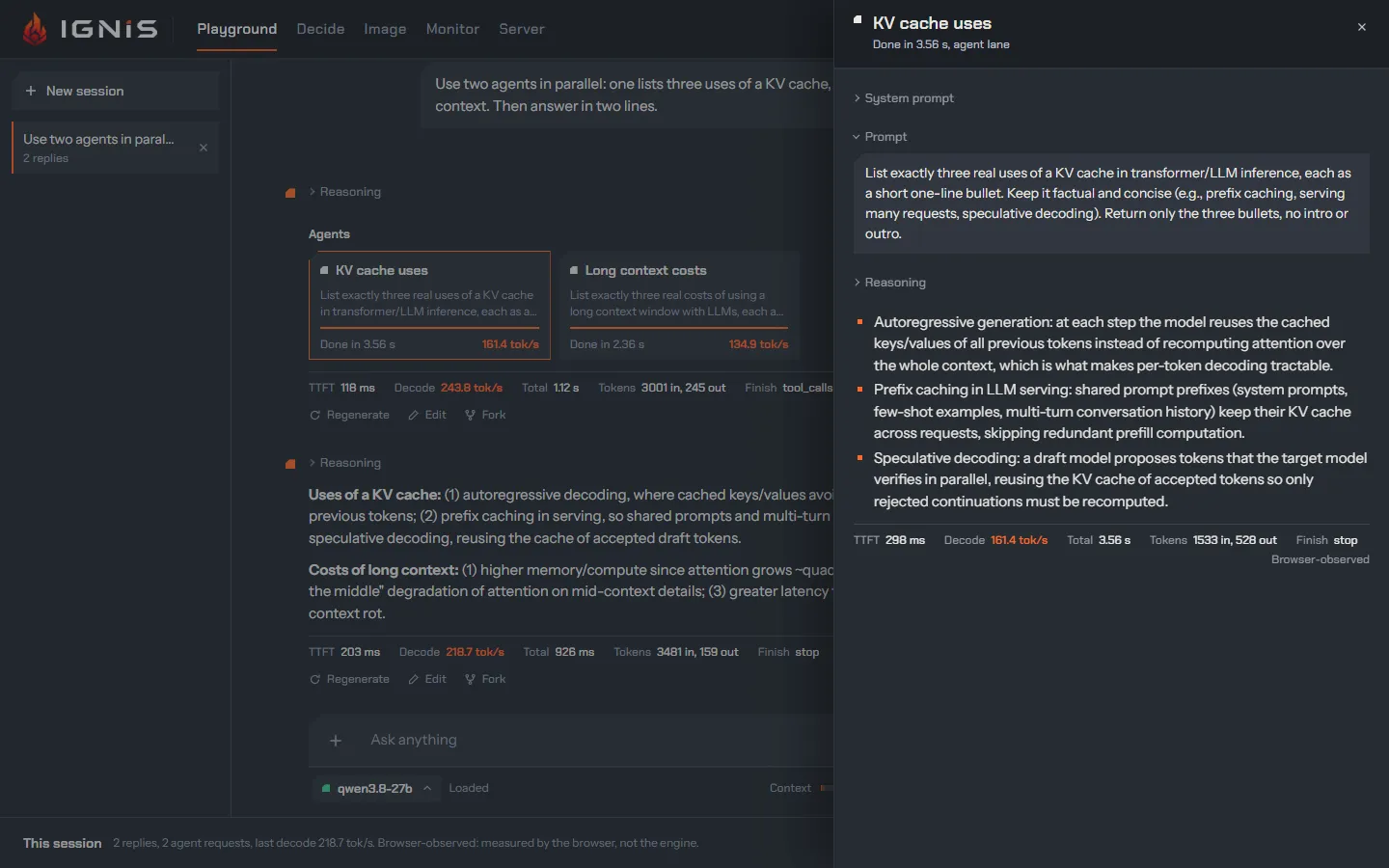
ignis.request.admittedcarries the backfill class;ignis.request.evictednames what was moved. - Playground: subagents run on
agentlanes, and the engine timings sit beside each reply (tools and agents, Monitor).
Limits
Section titled “Limits”- Two classes only. The engine the admission policy came from had three.
- One prefill lane: class orders the queue, it does not let a second prompt prefill at the same time.
- Class sets order, not a latency guarantee. When every tier is full of live work, the new request waits.
<id>@agentis also a model name to the server. See explicit and implicit switches for what a client that mixes names can trigger.
Read more
Section titled “Read more”- How ignis serves a request: admission in the path of a request.
- KV cache and prompt reuse: where evicted state goes.
- State that outlives its request: the tiers a lane’s state moves through.
- System One decisions, without decoding: why
/v1/decidedefaults toagent.