
Models that come and go
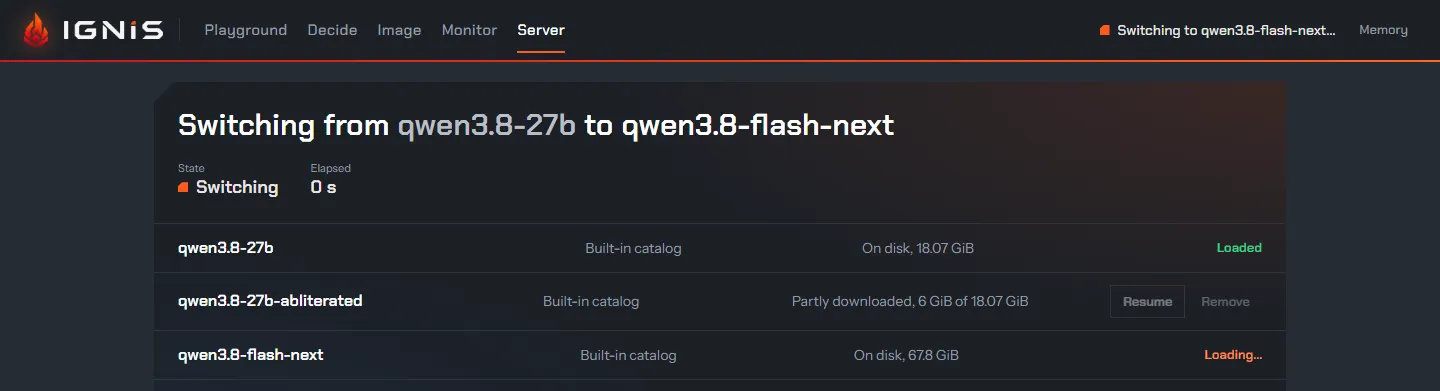
One card holds one model at a time, and the model that is loaded gets all of it. ignis turns that constraint into behaviour a client does not have to manage. A request that names another known model switches the server to it and is held until it serves, so there is no retry loop to write. After five minutes without a request the model is unloaded and the card is free for other work; the next request loads it again. The process, the listener, the metrics and the Playground stay up throughout.
How it works
Section titled “How it works”A load carves the card’s whole budget into one plan: weights, workspaces, lane
state, and then everything that is left goes to the KV pool, or to Flash-Next’s
expert cache. Two models would each need a plan, so a switch is a full reload:
the server drains the requests in flight (switch.drain_timeout), unloads, and
loads. POST /v1/models/switch does it explicitly. A request whose model
names another known model triggers the same switch (switch.allow_implicit)
and waits for it. GET /v1/models lists the loaded model first, then every
model whose weights are on disk; a model whose weights are gone is a 404 and
never tears the loaded one down.
Idle unload applies the same teardown on a timer. After model.idle_unload
seconds with no request in use and nothing waiting or running, the model is
unloaded and GET /v1/models shows status: "unloaded". Routes that only
report state (the model list, the configuration and catalog reads, /metrics)
neither count as use nor load the model, so an open Playground tab does not hold
it. The ADR weighed keeping the weights in pinned RAM, refusing until an
explicit load, and exiting, and rejected each.
Models arrive through a catalog. ignis-server model download <id> reads an
entry that pins every file at a revision with its byte count and SHA-256, so a
download is verified before it is used. download.catalog extends the catalog
for private models, and download.endpoint points at a mirror that answers the
Hugging Face resolve route (Artifactory, Nexus, a static server) for air-gapped
machines. The whole picture is in
Switching and idle unload.
The numbers
Section titled “The numbers”| Figure | Measured on | Source |
|---|---|---|
| 27B to the image model 10.0 s (server side 9,962 ms: teardown 908, load 9,021); image model back to the 27B 11.3 s (server side 11,246 ms) | RTX 5090, one live run | docs/specs/image-model/05-image-serving.md, the live run of 2026-10-14 |
| A cold load takes 13-33 s, which is what the first request after an idle unload pays | RTX 5090 | ADR 0049 |
model.idle_unload 300 s, switch.drain_timeout 30 s |
defaults | Configuration |
See it, control it
Section titled “See it, control it”- Switching:
switch.allow_implicit,switch.known_modelsandswitch.drain_timeout;POST /v1/models/switch, andGET /v1/modelswith itsstatus(serving,switching,loading,unloaded,failed) andlast_switch. - Idle unload:
model.idle_unload, 300 s by default and0for never. - The catalog:
GET /v1/models/catalog,ignis-server model download <id>,download.endpointanddownload.catalog. - Logs:
ignis.model.switch_started,ignis.model.loaded,ignis.model.unloaded,ignis.model.reloaded,ignis.model.load_failedandignis.model.switch_failed. The VRAM and KV pool gauges read zero while unloaded. - Playground: the Server view loads models and edits the running configuration.
Limits
Section titled “Limits”- There is never a second model on the card, not even the 27B beside the image model.
- The first request after an idle period pays a full load of 13-33 s. Benchmarks
and anything latency-sensitive should set
model.idle_unloadto0. - Alternating
modelstrings across clients makes the server ping-pong between models. Name one model per client; the pitfall of two names explains it.
Read more
Section titled “Read more”- Switching and idle unload: the full picture.
- Switching models and Get a model: the routes and the download.
- Air-gapped machines: the catalog on a mirror.